
Menopause: What Low Estrogen Changes, and What Actually Helps

After your last period, estrogen stops swinging and settles low for good. A hot flash is your brain’s thermostat overreacting to that drop. But how hard the thermostat swings depends on terrain: where your body makes its small supply of estrogen now, how your liver and gut clear it, how steady your blood sugar runs, and how much load is sitting on your adrenal glands. That is where I start, because that is where most of the leverage is. Hormones are one tool in that plan, and a good one. This post walks through all of it.
Perimenopause and menopause are two different seasons
Perimenopause is the years before the last period. Progesterone leaves first, estrogen swings high and low, and the symptoms come from the swinging: 3 a.m. wake-ups, new anxiety, periods arriving closer and heavier.
Menopause is the year mark after the last period and everything after it. The hormones are no longer swinging. They are low, and they stay low. That changes the question. In perimenopause I am chasing a pattern. After menopause I am asking what the drop has already cost, and how your body is handling what is left.
What low estrogen changes
The Study of Women’s Health Across the Nation followed more than three thousand American women through menopause for over twenty years, measuring their bodies as they went. Its findings explain most of what women describe to me.
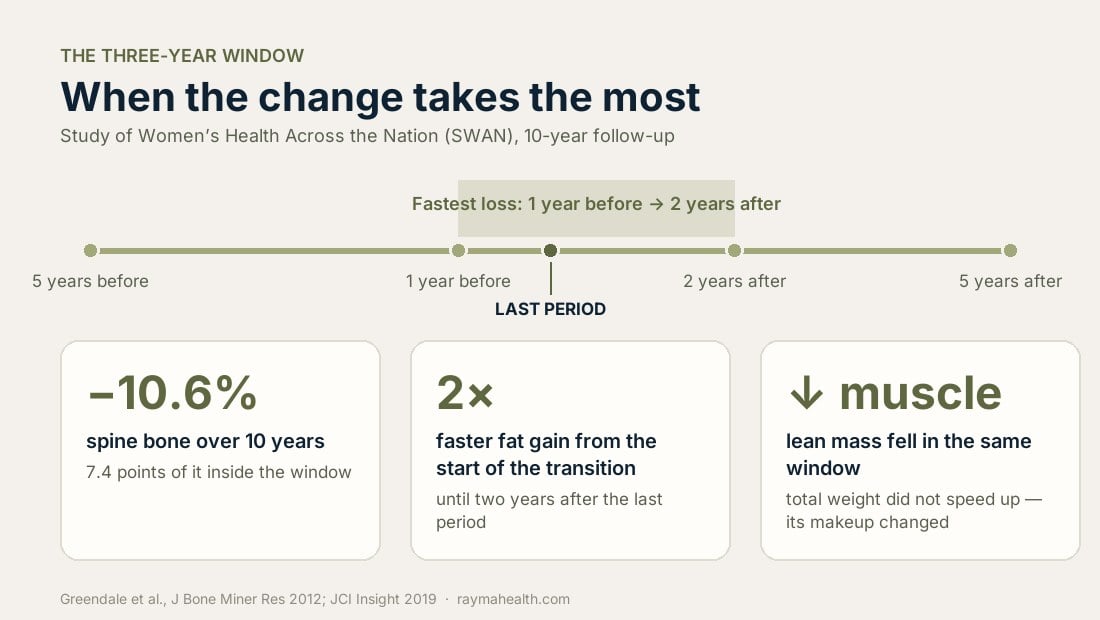
Bone. Bone loss began about one year before the final period and was fastest from then until two years after it. Across ten years, women lost 10.6% of the bone in their lumbar spine and 9.1% at the hip, and most of that loss happened inside that three-year window. Nobody feels bone leaving.
Muscle and the middle. In the same window, the rate of fat gain doubled and lean mass began to fall. Body weight did not accelerate at all. What the weight was made of changed. That is a terrain problem, not a willpower problem.
The heart. The American Heart Association’s 2020 statement puts it plainly: the menopause transition is a time of accelerating cardiovascular risk, tied to the hormone shift itself and not just to age. In the same long study, women whose hot flashes were frequent and persistent had nearly twice the rate of later heart attacks and strokes. A flash that will not quit is your body raising its hand, and it is exactly the kind of signal we can act on.
The brain. Some good news. The learning-and-recall dip that so many women notice showed up clearly in testing during late perimenopause, then rebounded after menopause to where it had been. The fog is usually a season, not a destination.
Dryness and the bladder. The Menopause Society puts the prevalence of genitourinary symptoms after menopause between 27% and 84% of women, calls it underdiagnosed and undertreated, and notes that unlike hot flashes it does not improve on its own. It is also the most fixable symptom on this page and the one women are least likely to bring up. Please bring it up.
Where estrogen comes from now, and where it goes
This is the part most women are never taught, and it is the part that explains why two women with the same low estrogen level can have completely different menopauses.
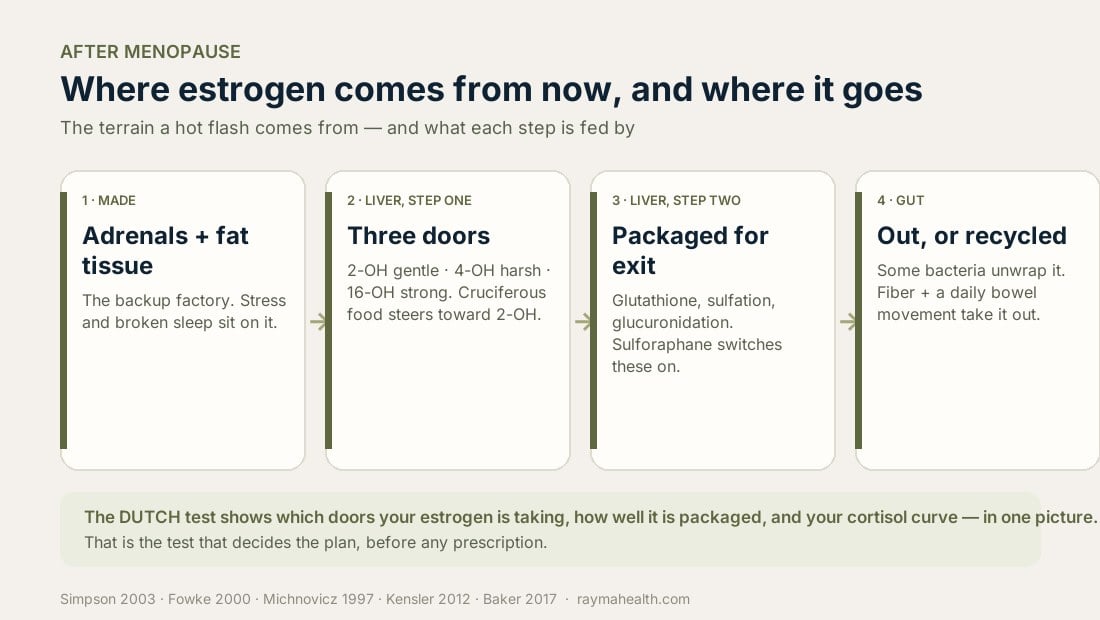
Where it comes from. After the ovaries retire, your body still makes a little estrogen. Your adrenal glands make the raw material, and an enzyme in your fat tissue and other tissues converts it into estrogen right where it is used. The adrenals are the backup factory. The catch is that the adrenals are also your stress glands. When cortisol is running the show for months on end, the backup factory is busy with something else. In a study of midlife women with hot flashes, the women with the most flashes had the flattest morning cortisol rise, a pattern that goes with chronic broken sleep. Stress and sleep are hormone work after menopause, not a side issue.
Where it goes. Estrogen has to be cleared, and clearance is a three-step job.
- The liver, step one. Estrogen leaves through one of three doors. The 2-hydroxy door is the gentle one. The 4-hydroxy door makes a metabolite that can damage DNA. The 16-hydroxy door makes a metabolite that still acts like strong estrogen. Which door your body favors is partly genetic and partly what you feed it. In postmenopausal women, eating more cruciferous vegetables shifted estrogen toward the gentle 2-hydroxy door, and a concentrated cruciferous compound raised 2-hydroxy output while lowering the 16-hydroxy metabolite.
- The liver, step two. Whatever comes through a door has to be packaged for exit, by glutathione, sulfation, and glucuronidation. This is the step sulforaphane switches on. In human trials, broccoli sprout extracts raised the body’s output of glutathione-packaged toxins by 20% to 50% within a week. That is the clearance system turning on in real people.
- The gut. Packaged estrogen goes out with bile into the gut. Certain gut bacteria carry an enzyme that unwraps the package and sends estrogen back into circulation. Fiber, a daily bowel movement, and a healthy microbiome keep it moving out. In women recently treated for breast cancer, those with the highest fiber intake had the biggest drop in hot flash severity over a year.
The DUTCH test shows which doors your estrogen is taking and how well it is being packaged, in one picture. That is why it is the first test I run after menopause, and why I often know what to do before we ever talk about a prescription.
Five things that calm the flash terrain
Broccoli seed extract, the sulforaphane source
This is the supplement I reach for first after menopause, and here is the reason. Sulforaphane is the compound in broccoli seeds and sprouts, and it does three jobs in this terrain. It switches on the liver’s packaging enzymes, the step above that gets estrogen and other hormones out the door. It belongs to the cruciferous family that nudges estrogen toward the gentle 2-hydroxy pathway. And it is one of the strongest natural activators of Nrf2, the body’s master switch for cooling inflammation and oxidative stress.
The cruciferous family shows up in the symptom data too: in a study of 365 breast cancer survivors, women eating the most cruciferous vegetables had half the odds of menopausal symptoms compared with women eating the least.
When a DUTCH test shows estrogen heading down the harsh 4-hydroxy door, or when a woman’s hot flashes ride along with inflammation, a sluggish liver, and a stressed system, broccoli seed extract is where I start, with the food that goes with it. The form matters: a seed extract standardized to sulforaphane, not powdered broccoli. Ask me which one.
Feed the exit
Eat the cruciferous family most days: broccoli, Brussels sprouts, cabbage, kale, cauliflower, arugula. Get fiber from vegetables, berries, beans, seeds, and nuts, and keep the bowels moving every day. Drink enough water that your urine runs pale. Keep a palm-sized portion of real protein at every meal, because muscle is still the organ that burns fuel and holds your blood sugar.
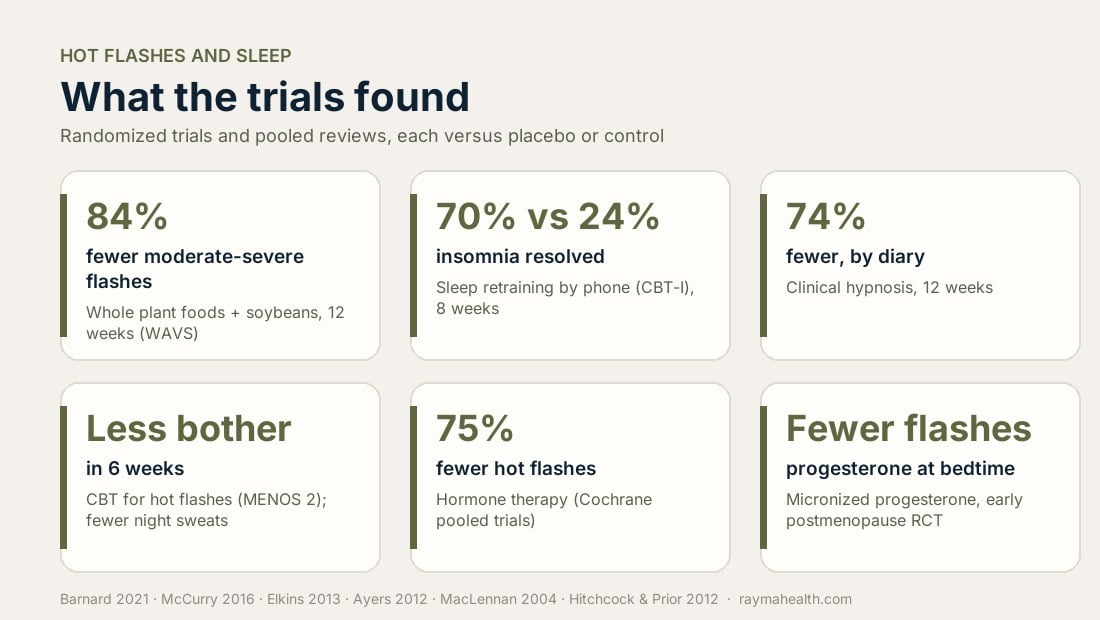
The food lever is bigger than most women think. In a twelve-week randomized trial, postmenopausal women who moved to whole plant foods with a half cup of cooked soybeans a day, and dropped the processed fat and sugar, cut their moderate-to-severe hot flashes by 84%, and more than half became free of them. In a large cohort of women followed through the change, a fruit-rich or Mediterranean-style pattern meant fewer hot flashes and night sweats, and a high-fat, high-sugar pattern meant more.
Keep your blood sugar boring
The belly fat of menopause and the blood sugar of menopause are the same problem. With less estrogen, cells respond to insulin less well and the body stores fuel at the middle instead of burning it. Fasting insulin starts rising years before a glucose or A1c flags anything, which is why fasting insulin is on my panel.
What steadies it: protein and fat before the carbohydrate, real food instead of crackers and bars, a ten-minute walk after your biggest meal, and lifting something heavy two or three days a week. Across 101 trials in postmenopausal women, strength training rebuilt muscle and trimmed visceral fat. Creatine monohydrate paired with that lifting adds lean muscle and leg strength on top. Exercise does not stop hot flashes on its own; what it does is protect the muscle, bone, blood sugar, and heart this season is working against, and that is the reason to do it.
Take the load off the adrenals
If the adrenals are the backup estrogen factory, then the nervous system is part of the hormone plan. Three things move the needle. Sleep retraining: in a trial of perimenopausal and postmenopausal women with insomnia and hot flashes, eight weeks of cognitive behavioral therapy for insomnia by telephone left 70% of women in the no-insomnia range, compared with 24% who received menopause education. Training the response to a flash: in the MENOS 2 trial, women taught to change how they react to a hot flash rated them far less of a problem within six weeks and had fewer night sweats. And clinical hypnosis: in a randomized trial, postmenopausal women cut their self-reported hot flashes by 74% over twelve weeks. These are not soft options. They are some of the best-tested tools we have.
Underneath them: morning light, a bedtime that holds, alcohol out of the evening, and something that puts the day down, a walk, a journal, prayer. And if the loudest thing in this season is grief for a part of your life or the question of who you are now, that belongs in the visit too. What you carry emotionally shows up in your body, and I treat it as part of the plan, not an extra.
Vitamin D with K2
Vitamin D helps you absorb calcium and K2 helps direct that calcium into bone rather than soft tissue. From October into March the Minnesota sun cannot make vitamin D in your skin, and it is the most common thing I find low on fall bloodwork. I test a level and dose from the number. If you take warfarin, ask me before adding K2.
And yes, hormones help
For the flash itself, hormone therapy is the most effective tool there is. In the Cochrane pooled analysis of placebo-controlled trials, it cut weekly hot flash frequency by 75%. It protects bone, and it treats dryness and bladder symptoms directly. The Endocrine Society and the Menopause Society agree on who it fits best: women under sixty or within ten years of their last period, without a specific reason not to. That is most of the women reading this.
In my practice hormones sit on top of the terrain work, not instead of it. A woman whose liver and gut are clearing estrogen well is a woman I am comfortable giving estrogen to, and the DUTCH tells me which pathways she is using before I prescribe.
Estradiol through the skin, not a pill: a patch, gel, or cream. In a French case-control study, oral estrogen carried about four times the risk of a venous clot compared with no hormones, while estrogen through the skin carried no measurable increase. Same hormone, different door.
Progesterone that matches your own, at bedtime: if you have a uterus, estrogen needs a partner to protect the lining. I use micronized progesterone, the molecule your body made, not the synthetic progestin from the 2002 trial that frightened a generation, where the breast cancer signal came from. When those same women were followed for eighteen years, hormone therapy was not associated with any increase in death from any cause. Taken at night, progesterone is also what gives many women their sleep back.
A tiny local dose for dryness and the bladder: low-dose vaginal estrogen stays where you put it, needs no progesterone with it, and the Menopause Society lists it as effective for moderate-to-severe symptoms. If that is your only symptom, it may be the only hormone you need.
Two things change the plan, and we build those differently: a history of breast cancer or another hormone-sensitive cancer, and a prior blood clot or stroke. Starting more than ten years past the last period, or after sixty, shifts the balance toward risk, so that conversation looks different. Once you start, I recheck you at three months and then yearly.
What I test after menopause
The question is no longer what your hormones are doing. We know. The question is what the drop has cost so far, and how your body is making, clearing, and responding to what is left.
- The DUTCH test, a dried-urine test you collect at home. It shows which doors your estrogen is leaving through, how well it is packaged, and your cortisol curve from morning to night. This is the test that decides the plan.
- Fasting insulin with your blood sugar, the belly-fat number, years ahead of the glucose
- A full lipid picture including ApoB, and an inflammation marker, because the heart risk above is real and measurable
- A full thyroid panel, because low thyroid produces the same tired, foggy, heavy picture
- Vitamin D and red blood cell magnesium, the two I most often find low and the two easiest to fix
Not everyone needs every one of these. What I order depends on your story, and there is a reason for every test.
Frequently asked questions
Can broccoli seed extract help with hot flashes?
It helps the terrain a hot flash comes from. Sulforaphane switches on the liver enzymes that package estrogen for exit, belongs to the cruciferous family that steers estrogen toward the gentler 2-hydroxy pathway, and cools inflammation through the Nrf2 switch. I use it first, with cruciferous food and fiber, especially when a DUTCH test shows estrogen heading down the harsh 4-hydroxy door. For flashes that stay heavy after that work, hormones are the next tool.
Do I have to take hormones to feel better after menopause?
No. Many women do well on terrain work alone: clearing estrogen well, steady blood sugar, muscle, sleep, and a lighter load on the adrenals. Hormone therapy is the most effective tool for the flash itself, and I prescribe it when it fits the woman in front of me, on top of that work.
How long do hot flashes last after menopause?
Longer than most women are told. In the Study of Women’s Health Across the Nation, frequent hot flashes lasted a median of 7.4 years and persisted a median of 4.5 years after the final period.
Is hormone replacement therapy safe after menopause?
For most women under sixty or within ten years of their last period, the Menopause Society and the Endocrine Society consider the benefit-risk balance favorable. In the 2002 Women’s Health Initiative trial’s eighteen-year follow-up, hormone therapy was not associated with higher all-cause, cardiovascular, or cancer mortality. The route and the type of progestogen matter: estrogen through the skin avoids the clot risk of pills, and micronized progesterone did not carry the breast cancer signal seen with synthetic progestins.
Why do I have belly fat after menopause when my diet has not changed?
Because the composition of your weight changed. Fat gain doubled its pace and lean mass fell from the start of the transition until two years after the final period, while total weight did not accelerate. Less muscle and less estrogen mean less insulin sensitivity, so the body stores at the middle. Lifting, protein, and steady blood sugar reverse the direction.
Do you order a bone density scan?
No. I treat bone through strength loading, protein, vitamin D with K2, and hormone therapy where it fits, and I follow the labs that tell me how the terrain is responding.
Let's look at your terrain, and build the plan.
I see patients in person at Rayma Health in Minnetonka. We read how your body is making, clearing, and responding to estrogen, and we build from there. Whether hormones belong in your plan is your call, made with the real numbers in front of you.
Educational content, not individual medical advice. Every plan at Rayma Health is built from your own history, labs, and goals.
Sources
- Greendale GA, Sowers M, Han W, et al. Bone mineral density loss in relation to the final menstrual period in a multiethnic cohort: results from SWAN. J Bone Miner Res. 2012;27(1):111-8. PMID 21976317 · doi:10.1002/jbmr.534
- Greendale GA, Sternfeld B, Huang M, et al. Changes in body composition and weight during the menopause transition. JCI Insight. 2019;4(5):e124865. PMID 30843880 · doi:10.1172/jci.insight.124865
- El Khoudary SR, Aggarwal B, Beckie TM, et al. Menopause Transition and Cardiovascular Disease Risk: A Scientific Statement From the American Heart Association. Circulation. 2020;142(25):e506-e532. PMID 33251828 · doi:10.1161/CIR.0000000000000912
- Thurston RC, Aslanidou Vlachos HE, Derby CA, et al. Menopausal Vasomotor Symptoms and Risk of Incident Cardiovascular Disease Events in SWAN. J Am Heart Assoc. 2021;10(3):e017416. PMID 33470142 · doi:10.1161/JAHA.120.017416
- Greendale GA, Huang MH, Wight RG, et al. Effects of the menopause transition and hormone use on cognitive performance in midlife women. Neurology. 2009;72(21):1850-7. PMID 19470968 · doi:10.1212/WNL.0b013e3181a71193
- The 2020 genitourinary syndrome of menopause position statement of The North American Menopause Society. Menopause. 2020;27(9):976-992. PMID 32852449 · doi:10.1097/GME.0000000000001609
- Avis NE, Crawford SL, Greendale G, et al. Duration of menopausal vasomotor symptoms over the menopause transition. JAMA Intern Med. 2015;175(4):531-9. PMID 25686030 · doi:10.1001/jamainternmed.2014.8063
- Simpson ER. Sources of estrogen and their importance. J Steroid Biochem Mol Biol. 2003;86(3-5):225-30. PMID 14623515 · doi:10.1016/s0960-0760(03)00360-1
- Reed SD, Newton KM, Larson JC, et al. Daily salivary cortisol patterns in midlife women with hot flashes. Clin Endocrinol (Oxf). 2016;84(5):672-9. PMID 26663024 · doi:10.1111/cen.12995
- Fowke JH, Longcope C, Hebert JR. Brassica vegetable consumption shifts estrogen metabolism in healthy postmenopausal women. Cancer Epidemiol Biomarkers Prev. 2000;9(8):773-9. PMID 10952093
- Michnovicz JJ, Adlercreutz H, Bradlow HL. Changes in levels of urinary estrogen metabolites after oral indole-3-carbinol treatment in humans. J Natl Cancer Inst. 1997;89(10):718-23. PMID 9168187 · doi:10.1093/jnci/89.10.718
- Kensler TW, Ng D, Carmella SG, et al. Modulation of the metabolism of airborne pollutants by glucoraphanin-rich and sulforaphane-rich broccoli sprout beverages in Qidong, China. Carcinogenesis. 2012;33(1):101-7. PMID 22045030 · doi:10.1093/carcin/bgr229
- Kensler TW, Chen JG, Egner PA, et al. Effects of glucosinolate-rich broccoli sprouts on urinary levels of aflatoxin-DNA adducts and phenanthrene tetraols in a randomized clinical trial in He Zuo township, Qidong, People’s Republic of China. Cancer Epidemiol Biomarkers Prev. 2005;14(11):2605-13. PMID 16284385 · doi:10.1158/1055-9965.EPI-05-0368
- Baker JM, Al-Nakkash L, Herbst-Kralovetz MM. Estrogen-gut microbiome axis: Physiological and clinical implications. Maturitas. 2017;103:45-53. PMID 28778332 · doi:10.1016/j.maturitas.2017.06.025
- Nomura SJO, Hwang YT, Gomez SL, et al. Dietary intake of soy and cruciferous vegetables and treatment-related symptoms in Chinese-American and non-Hispanic White breast cancer survivors. Breast Cancer Res Treat. 2018;168(2):467-479. PMID 29230660 · doi:10.1007/s10549-017-4578-9
- Gold EB, Flatt SW, Pierce JP, et al. Dietary factors and vasomotor symptoms in breast cancer survivors: the WHEL Study. Menopause. 2006;13(3):423-33. PMID 16735939 · doi:10.1097/01.gme.0000185754.85328.44
- Barnard ND, Kahleova H, Holtz DN, et al. The Women’s Study for the Alleviation of Vasomotor Symptoms (WAVS): a randomized, controlled trial of a plant-based diet and whole soybeans for postmenopausal women. Menopause. 2021;28(10):1150-1156. PMID 34260478 · doi:10.1097/GME.0000000000001812
- Herber-Gast GC, Mishra GD. Fruit, Mediterranean-style, and high-fat and -sugar diets are associated with the risk of night sweats and hot flushes in midlife: results from a prospective cohort study. Am J Clin Nutr. 2013;97(5):1092-9. PMID 23553160 · doi:10.3945/ajcn.112.049965
- Khalafi M, Habibi Maleki A, Sakhaei MH, et al. The effects of exercise training on body composition in postmenopausal women: a systematic review and meta-analysis. Front Endocrinol. 2023;14:1183765. PMID 37388207 · doi:10.3389/fendo.2023.1183765
- Daley A, Stokes-Lampard H, Thomas A, MacArthur C. Exercise for vasomotor menopausal symptoms. Cochrane Database Syst Rev. 2014;(11):CD006108. PMID 25431132 · doi:10.1002/14651858.CD006108.pub4
- Naddafha S, Antonio J, Kreider RB, Stout JR. Creatine monohydrate for lean mass, strength, and bone density in postmenopausal women: a systematic review and meta-analysis. J Int Soc Sports Nutr. 2026;23(1):2668435. PMID 42141930 · doi:10.1080/15502783.2026.2668435
- McCurry SM, Guthrie KA, Morin CM, et al. Telephone-Based Cognitive Behavioral Therapy for Insomnia in Perimenopausal and Postmenopausal Women With Vasomotor Symptoms: A MsFLASH Randomized Clinical Trial. JAMA Intern Med. 2016;176(7):913-20. PMID 27213646 · doi:10.1001/jamainternmed.2016.1795
- Ayers B, Smith M, Hellier J, Mann E, Hunter MS. Effectiveness of group and self-help cognitive behavior therapy in reducing problematic menopausal hot flushes and night sweats (MENOS 2): a randomized controlled trial. Menopause. 2012;19(7):749-59. PMID 22336748 · doi:10.1097/gme.0b013e31823fe835
- Elkins GR, Fisher WI, Johnson AK, Carpenter JS, Keith TZ. Clinical hypnosis in the treatment of postmenopausal hot flashes: a randomized controlled trial. Menopause. 2013;20(3):291-8. PMID 23435026 · doi:10.1097/gme.0b013e31826ce3ed
- MacLennan AH, Broadbent JL, Lester S, Moore V. Oral oestrogen and combined oestrogen/progestogen therapy versus placebo for hot flushes. Cochrane Database Syst Rev. 2004;(4):CD002978. PMID 15495039 · doi:10.1002/14651858.CD002978.pub2
- The 2022 hormone therapy position statement of The North American Menopause Society. Menopause. 2022;29(7):767-794. PMID 35797481 · doi:10.1097/GME.0000000000002028
- Stuenkel CA, Davis SR, Gompel A, et al. Treatment of Symptoms of the Menopause: An Endocrine Society Clinical Practice Guideline. J Clin Endocrinol Metab. 2015;100(11):3975-4011. PMID 26444994 · doi:10.1210/jc.2015-2236
- Manson JE, Aragaki AK, Rossouw JE, et al. Menopausal Hormone Therapy and Long-term All-Cause and Cause-Specific Mortality: The Women’s Health Initiative Randomized Trials. JAMA. 2017;318(10):927-938. PMID 28898378 · doi:10.1001/jama.2017.11217
- Canonico M, Oger E, Plu-Bureau G, et al. Hormone therapy and venous thromboembolism among postmenopausal women: impact of the route of estrogen administration and progestogens: the ESTHER study. Circulation. 2007;115(7):840-5. PMID 17309934 · doi:10.1161/CIRCULATIONAHA.106.642280
- Fournier A, Berrino F, Clavel-Chapelon F. Unequal risks for breast cancer associated with different hormone replacement therapies: results from the E3N cohort study. Breast Cancer Res Treat. 2008;107(1):103-11. PMID 17333341 · doi:10.1007/s10549-007-9523-x
- Chlebowski RT, Anderson GL, Aragaki AK, et al. Association of Menopausal Hormone Therapy With Breast Cancer Incidence and Mortality During Long-term Follow-up of the Women’s Health Initiative Randomized Clinical Trials. JAMA. 2020;324(4):369-380. PMID 32721007 · doi:10.1001/jama.2020.9482